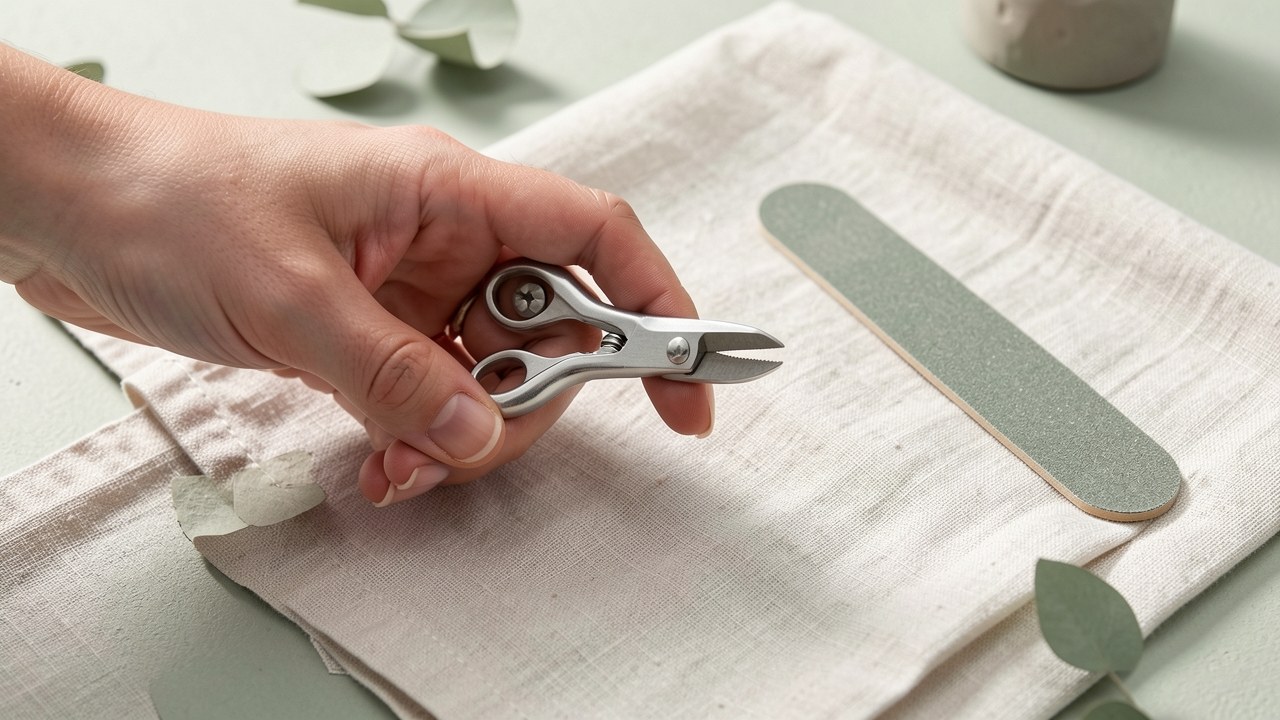
Tools needed for trimming and filing
Trimming and filing go faster and safer when the tool matches the nail. Fingernails and toenails are different thicknesses, so the same clipper rarely does both jobs well. Fingernail clippers or small nail scissors are appropriate for fingernails, while toenails are better served by a separate toenail clipper designed for thicker nails.
- A fingernail clipper or nail scissors for fingernails
- A heavier toenail clipper sized for thicker nails
- A nail file or emery board for smoothing edges and slightly rounding corners
- A small brush and 70 to 90 percent isopropyl alcohol for disinfecting tools
Sources: American Academy of Dermatology, Newswise (reprint of American Academy of Dermatology release), The Toe Nail Clinic, Advanced Ankle & Foot
Choosing a nail shape
Most everyday shaping is a decision about the corners, not the overall silhouette. Fingernails should be cut almost straight across, then the corners slightly rounded with a file or emery board to help keep them strong and prevent them from catching on clothing or furniture.
For toenails the priority changes. To reduce the chance of an ingrown toenail, toenails should be cut straight across rather than rounded. That single difference — rounded corners on fingers, square corners on toes — is the most useful shape rule to remember.
Sources: American Academy of Dermatology, Newswise (reprint of American Academy of Dermatology release)
How to clip safely, step by step
Clipping is easier and less likely to cause injury when the nails have been softened first. The best time to trim is right after a bath or shower, or after soaking the nails in lukewarm water for a few minutes. For feet, soaking in warm or warm soapy water for roughly 10 to 15 minutes softens the nail and the surrounding skin.
- Soften the nails with a bath, shower or a short soak in lukewarm water.
- Dry the hands or feet, and dry thoroughly between the toes.
- Make the cut in small, even steps rather than one deep bite.
- For toenails, cut straight across and leave a small margin of nail extending beyond the tip of the toe, roughly level with the tip of the toe.
- Do not cut down into the corners or into the surrounding skin.
- Smooth any rough or sharp edge or corner gently with a file or emery board.
Sources: American Academy of Dermatology, Newswise (reprint of American Academy of Dermatology release), Lighthouse Foot and Ankle, The Toe Nail Clinic, Achilles Foot and Ankle, Advanced Ankle & Foot
How to file in the correct direction
Filing is for smoothing and shaping, not for removing length in bulk. File the edge in one direction, in the same direction rather than back and forth, because sawing back and forth can weaken the nails.
Go lightly. The goal is a rounded corner on a fingernail and a softened edge on a toenail, not a thinned-out nail. After trimming, rough or sharp edges and corners should be smoothed gently with a nail file or emery board.
Sources: American Academy of Dermatology, Newswise (reprint of American Academy of Dermatology release), Lighthouse Foot and Ankle, Advanced Ankle & Foot, The Toe Nail Clinic, Achilles Foot and Ankle
Toenails versus fingernails
The two sets of nails follow the same basic order — soften, clip, file — but the details diverge in ways that matter.
Toenails grow more slowly than fingernails, so toenails may need trimming less often. A regular routine of trimming toenails about every few weeks helps avoid overgrowth and keeps the length safe, and trimming more often is preferable to cutting too short in one session. Cutting toenails too short can damage the nail bed and increase the risk of ingrown toenails.
Fingernails tolerate slightly rounded corners that follow the curve of the fingertip. Toenails do not: straight across is the safer shape. Tool choice follows the same split, with a separate, heavier clipper for toenails.
| Consideration | Fingernails | Toenails |
|---|---|---|
| Cut line | Almost straight across | Straight across |
| Corners | Slightly rounded with a file | Left square, not rounded |
| Length margin | Trim to a comfortable working length | Leave a small margin extending past the tip of the toe, roughly level with it |
| Tool | Fingernail clipper or nail scissors | Toenail clipper designed for thicker nails |
| Typical frequency | Trim as needed for length and snags | About every few weeks |
| Why the shape matters | Prevents catching on clothing or furniture | Reduces the chance of an ingrown toenail |
Sources: American Academy of Dermatology, Newswise (reprint of American Academy of Dermatology release), Lighthouse Foot and Ankle, The Toe Nail Clinic, Achilles Foot and Ankle
Common trimming and filing mistakes
Most problems trace back to a handful of habits. The first is cutting too short: cutting toenails too short can damage the nail bed and increase the risk of ingrown toenails. The second is rounding toenail corners, which is the trimming habit most associated with ingrown nails.
The third is filing back and forth instead of in one direction. The fourth is reaching for a tool that is too small for the job. And the fifth is skipping cleanup: nail tools should be disinfected about monthly by scrubbing them with a small brush in 70 to 90 percent isopropyl alcohol, then rinsing in hot water and drying completely before storage. Sharing tools is also worth avoiding, since sharing nail tools can increase the risk of spreading fungal infections.
- Cutting toenails too short instead of trimming more often
- Rounding or cutting into the corners of toenails
- Filing back and forth rather than in one direction
- Using fingernail clippers on thicker toenails
- Digging into the sides of a toenail or excavating the edge at home — this causes skin trauma, can drive the nail spike deeper and increases infection risk
- Leaving tools uncleaned or sharing them with others
Sources: American Academy of Dermatology, Newswise (reprint of American Academy of Dermatology release), Lighthouse Foot and Ankle, Advanced Ankle & Foot, The Toe Nail Clinic, Achilles Foot and Ankle
Looking after the nail and skin around it
The work does not stop when the clipper is put away. After trimming, moisturizing helps keep nails flexible, which is especially important when the air is dry because dry nails split more easily.
One area is best left alone. Cuticles should be left alone: cutting them or pushing them back can let bacteria and other germs enter and cause an infection. Moisturizer and the natural oil of the skin do enough for that area.
If you have soaked your feet before trimming, dry them thoroughly afterwards, including between the toes, since leftover moisture can contribute to fungal growth.
Sources: American Academy of Dermatology, Newswise (reprint of American Academy of Dermatology release), The Toe Nail Clinic
When a nail problem is not a technique problem
Ingrown toenails occur when the corner or edge of a nail grows into the nearby skin instead of outward, most often on the big toe. Trimming too short and rounding or cutting into the corners are recognized trimming-related risk factors for ingrown toenails.
But trimming is not the only factor. Tight or narrow footwear, a naturally curved nail shape, toe injuries, and moisture or sweating that softens the skin around the nail can all contribute.
Do not dig into the sides of a toenail or excavate the nail edge yourself. That causes skin trauma, can drive the nail spike deeper and increases infection risk. Redness, swelling, drainage or pus around a nail, persistent or worsening pain, or recurring ingrown toenails despite proper care are signs to seek professional care rather than continue home trimming. A nail change in color, texture or shape may be harmless or may be a sign of disease, such as melanoma or a fungal infection, and should be evaluated by a board-certified dermatologist.
Some people should consider professional help rather than forcing self-trimming: those with mobility issues that make reaching the feet difficult, thickened nails, or underlying health conditions. In older adults, nails tend to thicken and become more brittle, and conditions such as arthritis can make self-trimming harder, so toenail scissors with rounded edges or professional help may be considered.
Sources: American Academy of Dermatology, Newswise (reprint of American Academy of Dermatology release), Lighthouse Foot and Ankle, Advanced Ankle & Foot, The Toe Nail Clinic, Achilles Foot and Ankle, Ortopodoloji
Frequently asked questions
Should I cut my nails wet or dry?
Trim when the nails have been softened. The best time to trim is right after a bath or shower, or after soaking the nails in lukewarm water for a few minutes. For feet, a soak in warm or warm soapy water for roughly 10 to 15 minutes makes the nail easier to cut. If you soak your feet, dry them thoroughly afterwards, including between the toes.
Sources: American Academy of Dermatology, Newswise (reprint of American Academy of Dermatology release), The Toe Nail Clinic, Advanced Ankle & Foot, Lighthouse Foot and AnkleIs filing in both directions bad for nails?
File in one direction rather than sawing back and forth. Filing back and forth can weaken the nails, so keep the strokes moving the same way along the edge. Filing is also the finishing step, not the way to remove length: clip first, then smooth the edge and slightly round the corners of fingernails.
Sources: American Academy of Dermatology, Newswise (reprint of American Academy of Dermatology release), Lighthouse Foot and AnkleHow short is too short?
A toenail is too short when you cut into the surrounding skin instead of leaving a small margin of nail extending beyond the tip of the toe, roughly level with the tip of the toe. Cutting toenails too short can damage the nail bed and increase the risk of ingrown toenails. Trimming toenails more often is preferable to cutting too short in one session.
Sources: Lighthouse Foot and Ankle, The Toe Nail Clinic, Achilles Foot and Ankle, Advanced Ankle & Foot, OrtopodolojiWhat do I do if I clip a nail too short?
Stop trimming and do not dig into the sides of the nail or try to even it out, since that causes skin trauma, can drive the nail spike deeper and increases infection risk. Watch for redness, swelling, drainage or pus around the nail, or persistent or worsening pain. Those signs mean it is time to seek professional care rather than continue home trimming.
Sources: Advanced Ankle & Foot, Achilles Foot and Ankle, Lighthouse Foot and Ankle, The Toe Nail ClinicHow often should toenails be trimmed?
Trim toenails regularly, about every few weeks, to avoid overgrowth and maintain a safe length. Toenails grow more slowly than fingernails, so they may need trimming less often than fingernails. A steady, shorter trim is safer than one deep cut.
Sources: The Toe Nail Clinic, Advanced Ankle & Foot, American Academy of Dermatology, Newswise (reprint of American Academy of Dermatology release)How should I clean my nail clippers?
Disinfect nail tools about monthly by scrubbing them with a small brush in 70 to 90 percent isopropyl alcohol, then rinsing in hot water and drying them completely before storage. Avoid sharing tools, since sharing nail tools can increase the risk of spreading fungal infections.
Sources: American Academy of Dermatology, Newswise (reprint of American Academy of Dermatology release), Lighthouse Foot and AnkleDo I still need to moisturize after trimming?
Yes. After trimming, moisturizing helps keep nails flexible, which is especially important when the air is dry because dry nails split more easily. Leave the cuticles alone while you do it: cutting them or pushing them back can let bacteria and other germs enter and cause an infection.
Sources: American Academy of Dermatology, Newswise (reprint of American Academy of Dermatology release)What if an ingrown toenail keeps coming back even though I trim carefully?
Recurring ingrown toenails despite proper care are a sign to seek professional care instead of continuing home trimming. Other factors besides trimming can contribute, including tight or narrow footwear, a naturally curved nail shape, toe injuries, and moisture or sweating that softens the skin around the nail.
Sources: Advanced Ankle & Foot, The Toe Nail Clinic, Lighthouse Foot and AnkleSources
- How to trim your nails — American Academy of Dermatology
- How to trim your nails — Newswise (reprint of American Academy of Dermatology release)
- The Complete Guide to Properly Trimming Your Toenails - Lighthouse Foot and Ankle — Lighthouse Foot and Ankle
- How to Cut Toenails to Prevent Ingrown Toenails: A Step-by-Step Guide | Advanced Ankle & Foot — Advanced Ankle & Foot
- How to Safely Trim Your Toenails to Prevent Problems - The Toe Nail Clinic — The Toe Nail Clinic
- How to Prevent Ingrown Toenails: 12 Podiatrist Tips at Home — Achilles Foot and Ankle
- Things to Watch Out for When Cutting Your Nails to Prevent Ingrown Nails — Ortopodoloji